Sunday, 24 February 2019

NE Brazil Day 7: Chapada Diamantina

Our first taste of birding in the rain was this morning as we birded a wide valley in the Chapada Diamantina. It was only a shower in truth and once the weather cleared we saw some great birds with the endemic Sincora Antwren showing amazingly well just a few feet in front of us. 


The endemic Sincora Antwren

A calling Rufous-winged Antshrike was also pretty impressive but is a much more widespread species, and we also saw Lesser ElaeniaCinnamon Tanager, flyover Sooty Swift, the endemic Pale-throated Pampa-FinchGreen-winged and Black-throated SaltatorsGilt-edged TanagerViolet-capped Woodnymph, and at the bus we saw a Lowland Hepatic Tanager

Cinnamon Tanager

Pale-throated Pampa-Finch

But the star performer was a pair of Collared Crescentchests that provided point-blank views and pointedly disregarded my group.


The endemic Collared Crescentchest


Chapada Diamantina

Then we drove to another area but failed to locate Sao Francisco Sparrow but a showy Pearly-vented Tody-Tyrant and Plain-crested Elaenia was a little compensation. 

Lunch was in the nearby town and then we decided to keep on birding so headed to a particularly dry area of cerrado where Rufous-sided Pygmy-Tyrant and Grey-backed Tachuri proved easy to find despite the high temperature and blue midday skies. 

Grey-backed Tachuri - another endemic

Rufous-sided Pygmy-Tyrant - endemic

There was also American KestrelPlumbeous SeedeaterStripe-tailed Yellow Finch, and Wedge-tailed Grass-Finch. We checked out an area for Blue Finch without getting  response so headed back down to another area to look for Hooded Visorbearer, seeing 3 Red-legged Seriemas along the way (and good spotting from Gill and Mark). This was particularly scenic but as it was Sunday there were lots of people and no visorbearers although the endemic Velvety Black-Tyrant and Chopi Blackbird were new.


Saturday, 23 February 2019

NE Brazil Day 6: Lear's Macaw Reserve - Lencois

This was the day we had been waiting for, for a very long time! After a quick cup of coffee at 04:20 we left in a couple of 4-wheel drives and drove to a viewpoint to wait for daybreak. Walking along the path we disturbed a Scissor-tailed Nightjar and had a couple of views. 


This is the setting for the macaws

As the day slowly brightened we could hear the macaws stirring in the canyons below us and once it was light enough Ciro put his scope on a pair of Lear’s Macaws perched in a cactus not too far away. We watched them for quite a while before walking in a different direction and down to the edge of a big red sandstone canyon where dozens of macaws suddenly took flight and flew along the canyon below us. Wow! 


Lear's Macaw - classified as Critically Endangered

Over the course of the next couple of hours we watched several pairs of Lear’s Macaws flying to and fro below us and often at eye level. What stunning birds they are! There were also several pairs of Turquoise-fronted Amazons flying around and several groups of Blue-crowned Parakeets, as well as a  Campo Troupial feeding below us. As far as birding experiences go, this is right up there with the very best. You are literally in the 'middle of nowhere' watching one of the rarest birds in the world.This bird is listed as Critically Endangered and only lives in interior of northeast Brazil - so it is a bit of an adventure just to reach this area. And what a beautiful bird!

We returned to the lodge for a 07:30 breakfast during which time a Laughing Falcon was seen perched some distance away. So we eventually left this wonderful area after breakfast back at the lodge and set out on the 550km drive to Lencois and our next hotel, arriving at 6.30pm. A long drive indeed!


Friday, 22 February 2019

NE Brazil Day 5: Serra de Araripe - Lear's Macaw Lodge

So we left early doors and drove for a couple of hours to the famous water park where the extremely rare endemic Araripe Manakin resides. Along the way we made one stop where we found a pair of stunning Tawny Piculets before reaching the site. 


Tawny Piculet - endemic

A short walk into the forest soon has us watching up to 8 Araripe Manakins including a couple of stunning males feeding around us. Wow! This is possibly the top target of this tour and its such a stunning bird - can it get any better than this....? There was also a brief Black-tailed Myobius, Euler’s Flycatcher, Pectoral Sparrow and Little Woodpecker here but not a lot else.


Araripe Manakin - and yes it is endemic...

 From here we set out on the 350kms drive to our next lodge stopping at a couple of pools along the way to piuck up some new trip birds. The first one had Comb Duck, as well as Brazilian Teal, whilst the next one after lunch had our first White-cheeked PintailWood Stork, Pied Lapwing and Collared Plovers.

Comb Duck


White-faced Whistling-Ducks and Comb Ducks

As we neared the lodge we walked along the track through caatinga bush country and found hummers to be more plentiful here with Swallow-tailed Hummingbird, Glittering-bellied Emerald, Stripe-breasted Starfrontlet, Ruby Topaz and Broad-tipped Hermit. A superb pair of Spotted Piculets were much appreciated by everyone, and we also saw White-lined Tanager, Caatinga Barred and Silvery-cheeked Antshrikes, Brown-crested Flycatcher and Mouse-coloured Tyrannulet


Spotted Piculet - endemic

At the end of a long day we arrived at the Lear’s Macaw Lodge with a stunning vista from our rooms. Oh and pizza and beer in the local town was also pretty awesome tonight!


Wednesday, 20 February 2019

NE Brazil Day 4 - Serra de Araripe

After an overnight storm we woke to clearing skies (and it didn't stop the cockerel from crowing at 3am!!) and after a 5.30am breakfast we set off along the dirt road in the minibus. Our first stop was to check out an area of grassland that Ciro knew was good for Copper Seedeater and sure enough we enjoyed fine views of this scarce species. 

Copper Seedeater

However, this was completely overshadowed by the 3 Pinnated Bitterns we watched flying around the marsh below us and even had scope views of one stationery bird! Wow! Oh and I’m forgetting the pair of White-bellied Nothuras that we watched from the minibus as they walked along the track next to us. Not a bad start huh?

White-browed Antpitta - another NE Brazil endemic

Planalto Slaty Antshrike (female) - endemic

Anyway, things got even better if that’s at all possible when on entering the trail through some great caatinga forest we heard and eventually saw well, a pair of endemic White-browed Antpittas. Stunning birds and one to get the pulse racing for sure. Next up was a pair of Planalto Slaty Antshrikes posing well beside the path. An Ochre-cheeked Spinetail made a mockery of the previous poor views we’d had by prostituting itself in front of us! In between the mega birds we’d been finding consistently there were also some commoner things like Olivaceous Woodcreeper, Greenish Elaenia, Chestnut-vented Conebill etc. But next up was the mega endemic Great Xenops and we had repeated views of several individuals all along this trail. What a bird!  


Great Xenops - and yes, another endemic!

An Ash-throated Casiornis was a real surprise, whilst the superb views of Ochre-backed Woodpecker were awesome and a Caatinga Antwren was really cool too! 

Ochre-backed Woodpecker - endemic

Caatinga Antwren

A Golden-green Woodpecker, Flavescent Warbler and Sooty-fronted Spinetail rounded off our morning and we returned to the minibus by 11am in order to get back to the lodge for lunch and a long siesta, as boy its hot here!

At 3pm we set out in the minibus to another area of caatinga where the lodge owner knew about an active Spotted Piculet nest. We found the dead tree, saw the nest hole but no piculet. Instead we had a cracking view of an Ochre-backed Woodpecker at its nest hole! 

Ochre-backed Woodpecker - and still endemic

The same spot had White-crested and Mouse-coloured Tyrannulets and a pair of Chivi Vireos. A short walk along the track was good as we had a pair of Silvery-cheeked Antshrikes, and a fine ‘Caatinga’ Barred Antshrike – a potential split. 

Silvery-cheeked Antshrike - endemic

'Caatinga' Barred Antshrike - a potential split and another possible endemic 

A Long-billed Wren was also glimpsed here  but at our next stop most of us saw the wren better. A Tawny-crowned Pygmy-Tyrant appeared, along with an Ultramarine Grosbeak and a female Ruby Topaz but it was a little late in the day and things had died down, although we also saw Burnished-buff and Hooded Tanagers and a flyover Least Nighthawk. What a day...


NE Brazil Day 3 - Quixadá - Serra de Araripe

We had a quick walk around the grounds of the lodge seeing a few new birds such as Grey-necked Wood-RailSwallow-tailed HummingbirdGlittering-belling Emerald, and a flyover Lesser Yellow-headed Vulture.

Leaving here we drove for a good 5 hours, stopping beside a decent sized lake where we saw our first Black-bellied Whistling-Ducks and Muscovy Ducks, as well as Cocoi HeronStriated HeronPurple GallinuleWhite-headed Marsh-Tyrant, and quite a few commoner species. 


Masked Duck - phonescoped

On the other side of the road a Dark-billed Cuckoo posed nicely and we were surprised and elated to see a White-naped Xenopsaris fly into the same tree. Scanning from the same spot also revealed Brown-crested FlycatcherWhite-throated SeedeaterChestnut-vented ConebillSavanna HawkTropical GnatcatcherGrey Pileated Finch, and a stunning endemic Campo Troupial.

An hour later we pulled off the main road and drove for quite a while along a dirt track to our lodge. This place was a little rustic but was situated in the middle of nowhere. There were some feeders here with stacks of endemic Red-cowled Cardinals coming down, as well as endemic Pale Baywings and Shiny Cowbirds

Pale Baywing


Red-cowled Cardinal

After a siesta we walked along the trails and out into the Caating habitat. Close to the lodge we scored with a pair of Stripe-backed Antbirds and a pair of endemic Red-shouldered Spinetails. There was also a pair of Great Antshrikes here and despite the dense habitat everyone managed to see these birds. Nearby we saw both Lesser and Greater Wagtail-Tyrants in the same open area – both of which are due to be split in the near future. Continuing our walk we found Lined Seedeater, a Rufescent Tiger-Heron eating a huge frog, Hooded Tanager, and best of all a group of stunning endemic Scarlet-throated Tanagers. Initially only seeing a flock of females we eventually had a male fly in to the tree in front of us. 

Rufescent Tiger-Heron

Scanning from beside a large lake was good with White WoodpeckerWestern OspreySnail KiteLimpkinNeotropic Cormorant, and White-winged Swallow all being new additions to our list. Walking back to the lodge we saw a few Masked Ducks in a small pool, both Green-backed and Crested Becards in the same tree and an impressive flock of endemic White-bellied Seedeaters.


White-bellied Seedeaters

We ended the day with a close perched Lesser Yellow-headed Vulture at the lodge, quaffed a few beers and watched several Least Nighthawks flying overhead.


Lesser Yellow-headed Vulture


Tuesday, 19 February 2019

NE Brazil Day 2

We set off at first light to walk another trail through yet more excellent forest and the first bird of the day was a Red-cowled Cardinal perched by the minibus. We had just started along the trail when a Pale-legged Hornero appeared and shortly after seeing this we began a protracted but ultimately frustrating battle with an Ochre-backed Woodpecker. It showed several times but never out in the open, leaving most of the group with untickable views.  So moving on we saw Straight-billed WoodcreeperCommon WaxbillCaatinga PuffbirdBlue-winged ParrotletOrange-headed Tanager and Grey-headed Spinetail all quite well despite the low cloud and dull visibility. 
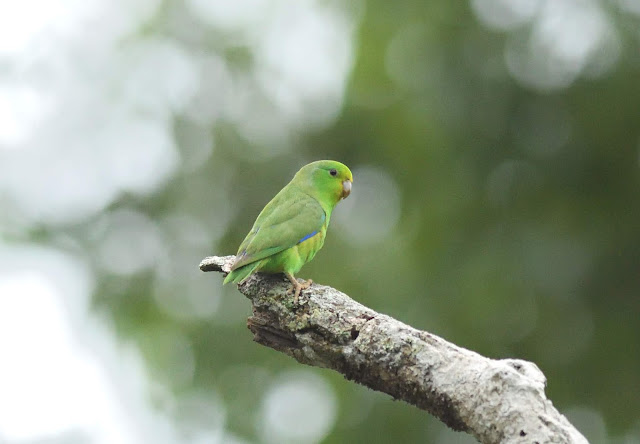
Blue-winged Parrotlet

Caatinga Puffbird

A Sooty-fronted Spinetail skulked low down in some bushes, a Plain Antvireo played hard to get, but a male Band-tailed Manakin showed very well. A Gray-lined Hawk flew around the hillside, and the next section of trail produced a Gray Elaenia that came in to check us out, there were further views of Ceara Gnateater, a stunning Red-billed Scythebill showed really well, Lafresnaye’s Woodcreeper would have blotted the sun out if it was indeed out, a few Burnish-buff Tanagers appeared, followed by a Large Elaenia, and the action never slowed. 

Ceara Gnateater

We did battle with Ochre-cheeked Spinetail once again but this time it actually showed at eye-level for a little while, and on the return a male Violaceous Euphonia was perched next to a female Purple-throated Euphonia and a pair of Little Woodpeckers fed beside the path.

After breakfast we left and drove some to hours to Quixada, driving through a scenery of Caatinga with low scrub and bushes. Species such as Savanna Hawk appeared and at a lake we scoped approx. 7 Masked Ducks amongst some White-faced Whistling-Ducks. At least 3 Southern Lapwings were also seen, as well as a pair of Yellow-chinned Spinetails. And then, after a ten minute drive we were driving up onto an escarpment amidst dry, arid caatinga and watching a pair of Pygmy Nightjars at their day roost beside the swimming pool of our hotel! There was also a flock of Biscutate Swifts flying over the hillside and a Black-chested Buzzard-Eagle as well. Brazil rocks!

Pygmy Nightjar

After a little siesta we walked along a trail and found Scaled Doves to be common, a pair of Common Tody-Flycatchers, Dark-billed Cuckoo, Variable Oriole and a pair of nesting Crested Becards. Luckily we dallied to watch the cuckoo as just then a pair of endemic White-browed Guans were spotted feeding across the pond and gave great views in the scope, along with endemic White-naped Jay and some White-tipped Doves. Walking up the hill we had several views of the endemic Ochre-backed Woodpecker, as well as Grey Pileated Finch, a pair of awesome Black-bellied Antwrens and a Rufous-browed Peppershrike. Scope views 
of the endemic Cactus Parakeet followed as we walked back down the track and just around the corner a Ferruginous Pygmy-Owl stared down at us from some bamboo. We walked to the edge of the escarpment and scoped a pool below where several Least Grebes could be seen and a Savanna Hawk was seen by all. The steep road down was productive with White-winged Becardand Greenish Elaenia in the same tree.

Ferruginous Pygmy Owl

The open fields and bushes were alive with birds. A mad half an hour produced White-browed Meadowlarks singing from exposed perches, endemic Caatinga Cacholotes were obvious, Chalk-browed Mockingbird and a Green-barred Woodpecker posed on some fence posts, a flock of endemic White-throated Seedeters were scoped, endemic Pale Baywings flew into some bushes in front of us, a Grassland Sparrow sang from a sparse bush and a pair of Brazilian Teals were seen.