Wednesday, 13 March 2019

NE Brazil Day 12: Serra Bonita

We were told when we arrived yesterday that Serra Bonita was having a drought and we need to conserve our water for showers etc. Well today it poured down with several very heavy showers whilst we were out on the trails. Anyway, the day began with a Short-tailed Nighthawk flying around the clearing near our rooms and walking to the main building for breakfast a Barred Forest-Falcon showed pretty well in the early morning gloom. 

Barred Forest-Falcon

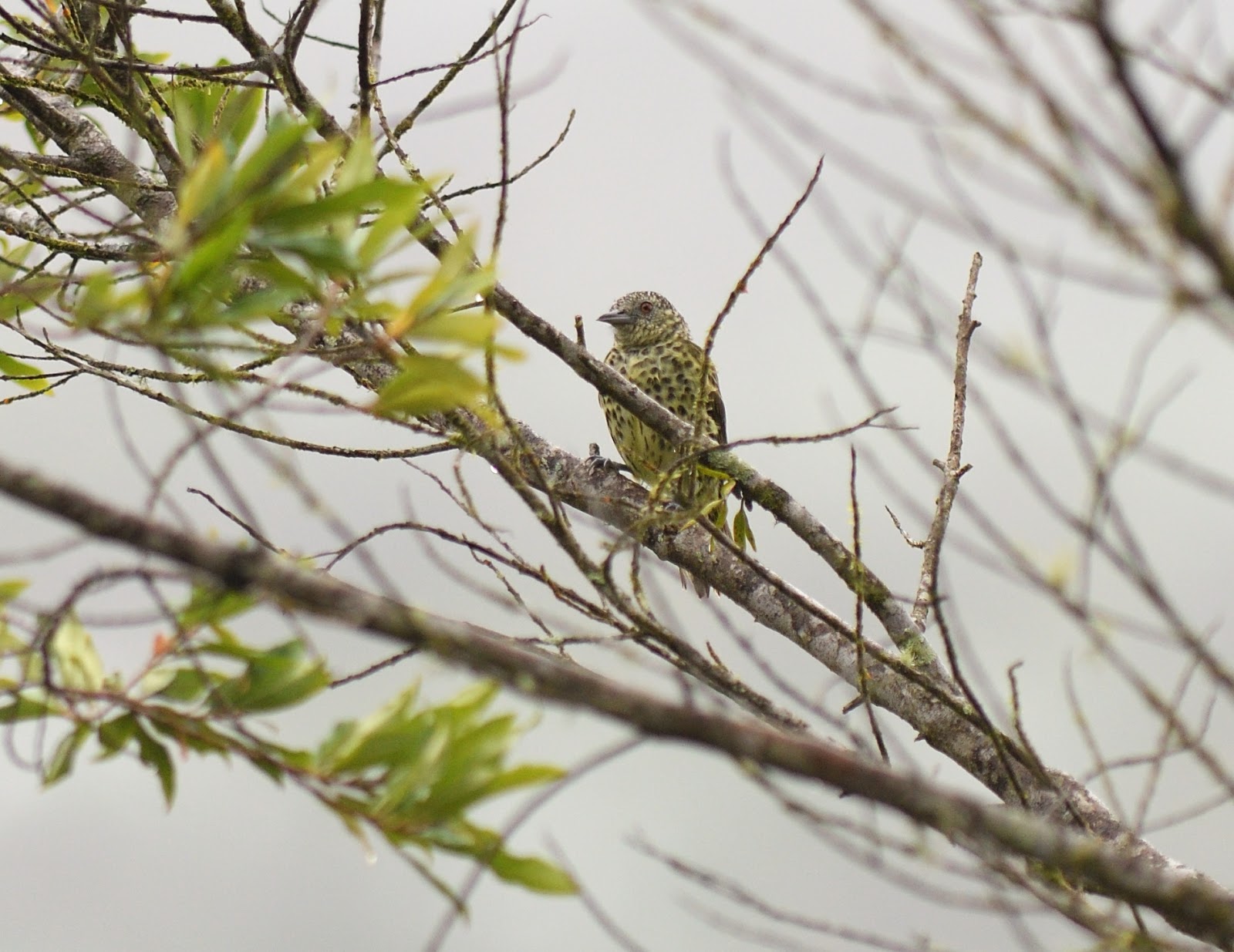
After breakfast a 4-wheel drive took us up to the radar tower and we began walking down the road, and low and behold the first bird was the endemic Bahia Tyrannulet. Nearby a Sharpbill was sitting out in the open, a Three-striped Flycatcher didn’t want to be seen and a Reddish Hermit was equally elusive. 

The first Sharpbill of the day

Continuing on a Surucua Trogon appeared, along with Yellow-legged Thrush, endemic Grey-hooded Attila at last, endemic Yellow-lored Tody-Flycatcher, and a male Spot-billed Toucanet was displaying over the road. 

Spot-billed Toucanet in the mist

We then followed an excellent trail and at a clearing we saw our first endemic Azure-shouldered Tanager, as well as Lemon-chested Greenlet, female Green-backed Trogon, Buff-throated Saltator, Variegated Flycatcher, Black Jacobin, endemic Sombre Hummingbird, Long-tailed Tyrant, and two more Sharpbills

Green-backed Trogon

Another Sharpbill

The trail wound its way through excellent forest and we hadn’t gone very far before coming across a pair of the elusive endemic Pink-legged Graveteiro feeding in the canopy above us. Wow! 


Pink-legged Graveitero - endemic

We’d looked hard for this bird yesterday and here we were getting pretty decent views. Next up was Black-capped Foliage-Gleaner that shot off before everyone could get on it. But when Ciro heard an endemic White-bibbed Antbird calling we couldn’t have expected to get such stunning views of this forest floor skulker, but this bird just sang away from its spot beside the trail and gave awesome views. 

White-bibbed Antbird - endemic

At the same time a Short-tailed Antthrush began singing and this too posed very nicely indeed from its song perch. Wow again! 

Short-tailed Antthrush

A short time later we had another White-bibbed Antbird displaying beside the track, puffing his white mantle feathers up and bowing up and down. Unbelievable! 


White-bibbed Antbird

The walk back to the lodge began to get quieter and the showers seemed to have stopped, but we still saw a pair of Spot-billed Toucanets along the way before Vito picked us up and took us to lunch. 

Crescent-chested Puffbird - endemic
Grey-hooded Attila - endemic
The afternoon session was quieter but we still enjoyed views of Crescent-chested Puffbird, White-necked Thrush,Lesser Woodcreeper, Black-throated Grosbeak, Grey-hooded Attila, and best of all a Mantled Hawk that we saw a couple of times. 


Sunday, 10 March 2019

NE Brazil Day 11: Serra Bonita

Left at 6am and drove for almost 5 hours to the lowlands of Serra Bonita Reserve, where for the past couple of months some fruiting palm trees have been playing host to some Banded Cotingas, one of the rarest endemics in Brazil. We bowled up in the heat of the day and after a short wait a superb male flew in for a brief time before being ‘buzzed off’ by some White-eared Parakeets. This spot was pretty good with a Silver-breasted Tanager (split from Opal-rumped Tanager) sat on a nest, a group of Yellow-rumped Caciques and a few Red-rumped CaciquesGrey-rumped Swifts flying over, Grey-crowned Flycatcher, a few beautiful Yellow-fronted Woodpeckers, the endemic Sombre Hummingbird and we also had some distant endemic Golden-capped Parakeets in the scope.

We had two 4-wheel drive vehicles to take us up to the lodge in the mountains and upon arrival we dumped our bags into the rooms and then had lunch. The feeders here enticed some Maroon-bellied Parakeets, both Red-necked and Green-headed TanagersPurple and Green Honeycreepers, and a pair of Wied’s Black-tufted Marmosets. At least 2 endemic Frilled Coquettes fed on some flowers in the garden as well. 

Frilled Coquette - endemic

Walking back to the rooms along the mountain road found us a Blue Manakin sat on a nest over the road, a pair of Pin-tailed ManakinsGreyish Mourner, Grey-capped Tyrannulet and a Green-backed Trogon. 

After an hour’s siesta we set off walking along the mountain track again but hadn’t got far when a Surucua Trogon was found. A viewpoint really got our pulses racing when Ciro exclaimed he had found a pair of endemic Buff-throated Purpletufts, and amazingly they flew in to some nearby trees to check us out. 


Buff-throated Purpletuft - endemic

Walking on there was Blue-naped Chlorophonia, endemic Pale-browed Treehunter, Plain-winged Woodcreeper, Yellow-throated Woodpecker, and anotherTufted Antshrike

Yellow-throated Woodpecker

Tufted Antshrike

We also tracked down a singing endemic Rufous-brown Solitaire and a calling White-eyed Foliage-Gleaner, as well as spotting a King Vulture circling overhead. 

We spent the remainder of the late afternoon staking out an area where we could see some Pink-legged Graveitero nests but there was no sign of their occupants so returned to the lodge for a shower before dinner.

Saturday, 9 March 2019

NE Brazil Day 10: Boa Nova Again!

So how do you follow yesterday? No idea but it was always going to be slower and it sure was. We followed a trail uphill through excellent forest and began with a female White-bellied Seedeater in the open area before entering the forest. A Black-necked Aracari was spotted by Mark and gave good views, whilst a pair of Black-capped Donacobius posed nicely in the marsh. Moving into the forest we had another view of Scale-throated Hermit and a Lineated Woodpecker appeared before we headed up the hill into dark and gloomy forest on a narrow trail. Always a group favourite! 

Rufous Gnateater

Anyhow a perched Rufous Gnateater was a good find and this race is likely to be split as it’s restricted to the mountains of Bahia state. Nice one! A Spot-breasted Antvireo was next up, followed by Red-stained Woodpecker, Greyish Mourner, Lesser Woodcreeper, a group of Flame-crested Tanagers and a few Yellow-green Grosbeaks. An East Brazilian Pygmy Owl showed much better and closer than yesterday’s individual, whilst Rufous-headed Tanager was also nice to see again and a Black-billed Scythebill also showed better than before. 

East Brazilian Pygmy Owl - found in E Brazil and East Paraguay

A cracking male endemic Scaled Antbird was new for us, as was Blue Manakin, and there was also Black-throated Trogon and an awesome Yellow-throated Woodpecker of the red-throated race. Hmmm… 

Black-throated Trogon

We walked up as far as we could go before the trail became too overgrown and steep, and at this point a Greenish Schiffornis appeared before we turned around and headed downhill. Our walk back was enlivened by Channel-billed Toucan, Sepia-capped Flycatcher,White-collared Foliage-Gleaner, a pair of Sibilant Sirystes high overhead in the canopy, Streaked Xenops, a few Black-throatedGrosbeaks, Long-tailed Tyrant, and both Bahia and Sooty-fronted Spinetails. Beside the minibus a Yellow-lored Tody-Flycatcher showed very well in the shade of a Cecropia tree.


Yellow-lored Tody-Flycatcher - endemic

After a long siesta back at the hotel we headed to the cerrado zone and tracked down the endemics Long-billed Wren and Grey-eyed Greenlet that had pretty much eluded us until now. A group of endemic Scarlet-throated Tanagers were also here, along with the endemic Campo Troupial, a Black-capped Antwren and others. 


Black-billed Scythebill

We drove further along the dirt track and came to the same spot as yesterday afternoon and this time found Mouse-coloured Tyrannulet, Swainson’s FlycatcherSilvery-cheeked Antshrike, Black-billed Scythebill, female Planalto Slaty Antshrike, Little Woodpecker and White-shouldered Fire-eye

Tawny-browed Owl

We waited for dark and then Ciro called in a superb Tawny-browed Owl that gave fine views to end the day on a big high.


Wednesday, 6 March 2019

NE Brazil Day 9: Boa Nova

This was our busiest morning of the tour so far as we followed a trail into the Atlantic Rainforest and were bowled over by the volume of new trip birds with a constant flow of new species making it hard at times to keep up. We started birding the trail at 06:30am with Saffron Finch, endemic Brazilian TanagerRufous-winged Antwren and the endemic Yellow-lored (Grey-headed) Tody-Flycatcher all showing well. The endemic Bahia Spinetail then showed reasonably well as it crept up a vine tangle and whilst watching this an endemic Rio de Janeiro Antbird appeared. Moving on Ciro called in an endemic Crescent-chested Puffbird that posed nicely in front of us, and we followed this with several sightings of Red-crowned Ant-TanagerGreyish Mourner, flyover Channel-billed ToucanVariable Antshrike and an endemic Rufous-headed Tanager fed quietly high up in the canopy above us.


Crescent-chested Puffbird - endemic

And the birds kept on coming with Fork-tailed Tody-Tyrant skulking in the tangles in front of us, Moustached Wren, a superb endemic White-collared Foliage-Gleaner that showed really well, and a pair of Tufted Antshrikes also came into the same spot. Following a few gulps of water there wasn’t much time for a pause in proceedings as female Pin-tailed Manakin was seen a few times, along with a scoped Long-tailed Tyrant, the endemic race of Golden-spangled Piculet, which is sometimes known as Bahia Piculet. Nearby a Whiskered Myiobius showed, and just then a Sharp-tailed Streamcreeper appeared in the small stream below us. 


White-collared Foliage-Gleaner - endemic

Whiskered Myiobius

What followed this was simply amazing as we came across a large mixed feeding flock with a number of really great birds present. We began with a pair of Chestnut-crowned Becards overhead, followed by a couple of endemic Striated Softtails feeding in the tree above us, Tropical Pewee and Rufous-winged Antwren. And more birds kept appearing with the endemic Pallid Spinetail, another Spotted Piculet (endemic), Black-eared FairyWhite-necked Thrush and another Rufous-headed Tanager (endemic). A trio of woodcreepers passed by: Northern Lesser and Scaled (both endemics) and a huge White-throated Woodcreeper. The action was relentless with Red-crowned Ant-TanagersPlain XenopsSquirrel CuckooLittle Woodpecker, a superb Spot-backed Antshrike, and a Golden-crowned Warbler. Phew!

It was getting pretty hot by now but we continued walking a little further seeing Euler’s FlycatcherPectoral Sparrow, a pair of Yellow Tyrannulets, a Scale-throated Hermit flew around us, Violet-capped Woodnymph posed and a superb Least Pygmy-Owl flew in that attracted Rufous-browed PeppershrikeYellow-olive Flatbill and other common birds to mob it. 


Scale-throated Hermit

Next up was Drab-breasted Bamboo-Tyrant showing quite well in the shadows, female White-bearded ManakinViolaceous EuphoniaYellow-bellied ElaeniaGolden-chevroned Tanager and Sooty Grassquit before we decided it was way too hot to continue and started walking back to the minibus. Along the way we saw Short-crested Flycatcher,White-shouldered Fire-Eye, and a Black-billed Scythebill that showed just a couple of times but never perched out in the open. Near the waiting minibus we fond a group of Black-necked Aracaris feeding in a fruiting tree and a pair of Striated Softtails performing well in front of us. And that was our morning, so we drove 25 minutes back to the hotel arriving just after 11am for an early lunch and a siesta.


Striated Softtail - endemic

In the afternoon we visited a drier area of habitat and spent a while finding the endemics Narrow-billed Antwren and the stunning Slender Antbird– but we did. 

Slender Antbird - endemic

Slender Antbird is a fascinating species, as it is endemic to the Brazilian Atlantic forest of SE Bahia and NE Minas Gerais states, where it is further restricted to mato-de-cipo woodland on hillsides - so it's pretty localised!

Also seen here were the endemic Hangnest Tody-Tyrant,  and a female endemic Planalto Slaty Antshrike

Planalto Slaty Antshrike


Crane Hawk

Walking on we had a flyover Crane Hawk before driving to an open area where some hummers were feeding on flowering cacti. New for us was a Sapphire-spangled Emerald and also a Rufous-fronted Thornbird. But the endemic Dubois Seedeater was a bonus here.

Then we drove to a marsh I the forest where we had a flyover Short-tailed Nighthawk before incredibly a Giant Snipe flew down and landed right in front of us. A much-wanted bird for everyone including yours truly who had dipped on this species in Brazil some 9 years ago. What an incredible bird!


Giant Snipe - wow!

A Common Pauraque on the track as we drove out was the last new trip bird of the day!


Tuesday, 26 February 2019

NE Brazil Day 8: Chapada Diamantina

Well, what a night that was! Driving rain began before midnight and it was still chucking it down at breakfast and throughout the 2 hour drive to our first stop of the day. It eased quite a bit by the time we arrived but it was still steady drizzle and not the best conditions to find hummers and in particular the endemic Hooded Visorbearer. One of Ciro’s contacts had informed him last night  about an area where there was a profusion of flowers particularly attractive to hummers and so we altered our plans and headed straight there. But man it was raining. So donning ponchos and wielding those pesky umbrellas we set off along a flat track and within 2 minutes we’d found a Hooded Visorbearer – huge relief all round and big smiles from everyone.

Hooded Visorbearer - endemic

According to The Cornell Lab of Ornithology: "The Hooded Visorbearer is endemic to the central part of the state of Bahia, where it inhabits arid and semi-arid montane scrub (at 950–1600 m) rich in cacti, bromeliads, and terrestrial orchids and is listed by BirdLife International as Near Threatened on account of its small range." 

In fact, there were hummers everywhere. I would ay we saw at least 6 or 7 visorbearers and the views were quite exceptional as the males were on territory and utilising any prominent perch to watch over their domain. There was also a couple individuals of Brown Violetear – this is an isolated population and the subject of much discussion regarding whether it is in fact a separate species. 

Brown Violetear

We saw one of these birds constantly harassing a Swallow-tailed Hummingbird as it tried to feed on its territory. The most abundant hummer was White-vented Violetear and we also enjoyed crippling close-ups of this pretty bird as well, and there was a few Glittering-bellied Emeralds to complete the picture. 

A very soggy Swallow-tailed Hummingbird

White-vented Violetear

As well as this spectacular hummingbird spectacle we also saw Spix’s Spinetail, White-bellied Seedeater, Masked Yellowthroat, Rufous Hornero and a flyover Aplomado Falcon.

Masked Yellowthroat

Leaving here the weather had totally cleared up so we drove to another area of cerrado and walked along another flat track with a wide open vista. A pair of Rusty-backed Antwrens appeared close by, a few Shrike-like Tanagers were really nice, a Pale-breasted Spinetail came in to check us out, there was a group of at least 6 Fork-tailed Flycatchers, and there were several White-eared Puffbirds dotted around. 

Rusty-backed Antwren

White-eared Puffbird

White-banded or Shrike-like Tanager

So leaving here we made our second attempt at the endemic Diamantina Tapaculo and this time were treated to crippling views as one bird appeared just a few feet away. Wow! 

The endemic Diamantina Tapaculo

A group of endemic East Brazilian Chachalacas in the same area tried their best to remain unseen but failed! I must say the views we have been getting of most species on this tour have been outstanding. So from here we drove a short distance to a restaurant and afterwards set out on a 250kms drive to our base for the next 3 nights at Boa Nova.